
The Best Kisser Paradox
I'm Thinking of Ending ThingsA story about a teenager and her driving instructor develops into an argument about whether intimacy can exist without another person’s participation.
increasing Bearing strength in each event
 decreasing
Bearing strength in each eventdecreasingThe Driving Lesson

The Driving Lesson
A peculiar instructor
The narrator recounts meeting Doug during a rainy driving lesson. He gives her a book, discusses experience, and treats the lesson as a conversation.
A story inside the drive
The memory seems to reveal an earlier encounter that the narrator has never shared. Its details later prove important to the novel’s questions about memory and invention.
The Candy Wrapper

The Candy Wrapper
A translated poem
Doug shares an unusual candy and reads its awkwardly translated wrapper. He treats the lines as a puzzle and a possible comfort against loneliness.
Meaning in fragments
The wrapper’s strange language invites interpretation rather than certainty. Its importance comes from the effort to make meaning from incomplete signs.
The Best Kisser Claim

The Best Kisser Claim
A boast becomes a question
The narrator says a young student claimed to be the world’s best kisser. Doug becomes troubled by what the claim would mean if kissing requires another person.
Excellence requires relation
The story turns a boast into a philosophical problem: a shared act cannot be judged by one participant alone. The exchange echoes the narrator’s desire for mutual recognition.
Jake’s Interpretation

Jake’s Interpretation
An assumed ending
The narrator tells Jake the driving lesson story, but he assumes she kissed Doug. His interpretation makes the anecdote more dramatic than the actual ending she later gives.
A gap between tellings
Jake’s assumption shows how a listener can reshape a story before its teller finishes. Their exchange enacts the novel’s suspicion that stories alter events.
The Actual Ending
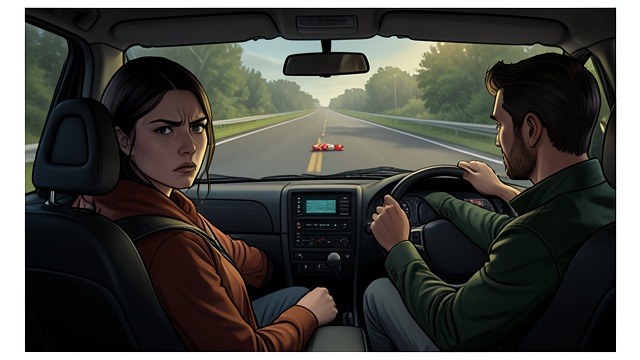
The Actual Ending
A different gesture
The narrator finally reveals that she returned to show Doug the candy wrapper, not to kiss him. She read the second poem and ran back inside.
Intimacy must be mutual
Her correction restores the distinction between a kiss and a one-sided action. The story becomes a compact model of consent, connection, and interpretive error.
When the narrator is sixteen
During the rainy lesson
Later in the driving lesson
During the drive to the farm
After Jake’s interpretation
